
With the earnings season drawing to a close, stock markets will take cues from global trends and foreign investors' trading activity this week, analysts said. The US FOMC (Federal Open Market Committee) minutes will be the major highlight this week, experts said. "This week, there are fewer cues on the macro and micro fronts, as the Q1 earnings season has concluded.

The finance ministry said on Tuesday that high energy and commodity prices due to the Russian invasion of Ukraine may provide an upside risk to inflation and continued vigil is required. "Going forward, elevated energy and commodity prices may act as an upside risk to the inflation outlook in the near-medium term. "Given the inherently unsustainable nature of high prices, international commodity prices are expected to level off early with an increase in supplies outside the crisis zone," the department of economic affairs said in its latest monthly economic report for February.

'To the believers of crypto regulations, I have only one question to ask, how will you regulate it?'

'A 10 to 15 per cent allocation to gold in portfolios reduces risk without compromising on potential returns.'

'Given the inherent volatility, investors should take at least a three to five-year view.'

the largest transactions of the year include the merger of Quality Care India and Aster DM Healthcare valued at $5.08 billion, followed by Bharti Enterprises' acquisition of a 24.5 per cent stake in the BT Group at $4.08 billion, and a family settlement transaction in the Godrej family at $3.5 billion.

'If you look at where inflation (headline and core) is today in India and where the rates are, there's clearly room to cut rates.'

'Investors looking at the next 6-12 months can be certain that the Fed will maintain its easing cycle, and we expect the overall environment to be conducive for fixed income investments for portfolio diversification.'

'Allocate up to 20 per cent of your core equity portfolio to quality funds.'

'While my generation carries with it the memory of the Chinese perfidy of 1962, this generation will carry the memory of Chinese perfidy in Galwan.'

'Consider your household's financial health and all your other goals.' 'Buying a house might seem like an urgent goal, but it is rarely the only one.'

Macroeconomic data announcements, the Covid situation in China and global market cues would guide Dalal Street in the first week of trading in the New Year, analysts said. Markets would also keep a track on rupee movement, Brent crude oil prices and foreign fund investment trends. "As market players attempt to understand the Fed's stance, Indian markets may respond in lockstep with their international counterparts when the Federal Open Market Committee (FOMC) minutes are made public later this week.

United States President-elect Donald Trump's plan to overhaul the government with a new department headed by tech billionaire Elon Musk and Indian-origin entrepreneur Vivek Ramaswamy will be a biggest threat for China as it has to compete with far more efficient US political system, a policy advisor to the Chinese government said.

Reserve Bank on Thursday retained the growth and inflation projection at 7.2 per cent and 4.5 per cent respectively for the current fiscal amid expectations of a normal monsoon. In its last bi-monthly monetary policy review in June, RBI had projected real GDP growth and retail inflation at the same.

The rupee plunged 58 paise to close at an all-time low of 81.67 (provisional) against the US dollar on Monday as the strengthening of the American currency overseas and risk-averse sentiment among investors weighed on the local unit. Moreover, escalation of geopolitical risks due to conflict in Ukraine, a negative trend in domestic equities and significant foreign fund outflows sapped investor appetite, forex traders said. At the interbank foreign exchange market, the local currency opened at 81.47, then fell further to close at an all-time low of 81.67 against the American currency, registering a decline of 58 paise over its previous close.

'Future market gains will likely depend primarily on earnings growth.'

'The central bank has highlighted that the slowdown in growth has been limited to a few sectors and overall growth is expected to pick up in the second half of the year.'

With the prediction of an above normal monsoon in 2024, the government is expecting food prices to come down, the finance ministry's monthly economic report for March has said. The report, released on Thursday, said robust foreign inflows and comfortable trade deficits were expected to keep the rupee within a comfortable range. "Further easing of food prices is on the anvil as IMD (India Meteorological Department) has predicted above-normal rainfall during the monsoon season, which is likely to lead to higher production, assuming good spatial and temporal distribution of the rainfall," the monthly report, released by the Department of Economic Affairs, said.

If technical analysts are to be believed, the index has more room for a slide down to 72,000 levels in the worst-case scenario, wiping out all the gains made in 2024 so far.

ABB reported a weak quarter. Revenue was at Rs 2,910 crore, up only 5 per cent year-on-year (Y-o-Y), with operating profit at Rs 540 crore, up 23 per cent and net profit at Rs 440 crore.
The surge in volatility across the globe sparked by Russian invasion of Ukraine has led to an increase in prices of gold and silver - considered to be safe-haven investment bets. In the past month, silver funds have delivered returns of 7.34 per cent, while gold funds on an average have risen around 6 per cent. In comparison, the benchmark Nifty has declined 4 per cent. Fund managers say precious commodities act as a good hedge against inflation and phases of geopolitical uncertainty.

'We expect market consolidation and recommend buying during market dips.'

'Whether I am optimistic or pessimistic is not the issue; I am just going by the evidence available.' 'The Indian economy and financial sector are now well-placed and very resilient in dealing with any kind of spillover coming from the external world.'

'Investors can consider staying invested in long duration products as there is a possibility of rate cuts in the near term.' Positive macros - lower inflation, high forex reserves and favourable demand-supply dynamics for government bonds - make a strong case for rate cuts from December, says Devang Shah, head of fixed income, Axis Mutual Fund. In an interview with Abhishek Kumar in Mumbai, Shah says this view may not hold true if commodity prices go up sharply.

The Reserve Bank is unlikely to cut the benchmark interest rate in its forthcoming bi-monthly monetary policy review later in the week as retail inflation is still a cause of concern, and there is a possibility of the Middle East crisis deteriorating further, impacting crude oil and commodity prices, say experts.

Equity indices chalked up losses for the second straight session on Monday, in tandem with a bearish trend overseas as ratcheting up of hostilities in Ukraine and prospects of further rate hikes by the US Fed soured global risk sentiment. The rupee slipping to another all-time low against the US dollar amid foreign fund outflows added to the gloom, traders said. After tumbling over 800 points in intra-day trade, the 30-share BSE Sensex clawed back some lost ground to end 200.18 points or 0.34 per cent lower at 57,991.11.

Most investors should have a 5% to 10% allocation to gold for diversification. They should stagger their investments to mitigate timing risk.

The size of Reserve Bank's balance sheet increased by 11.08 per cent to Rs 70.47 lakh crore as on March 2024, leading to the highest-ever dividend payout to the government, according to the central bank's annual report. In actual terms, the increase was Rs 7,02,946.97 crore over Rs 63.45 lakh crore as on March 2023.

'We emphasise the importance of not basing investment decisions solely on electoral outcomes.' 'Instead, focusing on investing in high-quality businesses capable of prospering regardless of the political landscape is paramount.'

Moody's Investors Service on Wednesday said the outlook for global banks for 2024 is negative as central banks' tighter monetary policies have resulted in lower GDP growth. It said Indian banks' profitability will increase further on lower provisioning expenses and robust growth in higher-yielding retail segments. "Our outlook for global banks for 2024 is negative as central banks' tighter monetary policies have resulted in lower GDP growth.

TVS Motor Company met expectations in terms of revenue and posted a strong margin performance in Q1FY25. The key drivers were material cost savings and a better mix. The domestic demand outlook looks good with a rural rebound but geopolitical uncertainties in key export markets may dent overall growth.
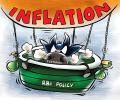
The Reserve Bank of India on Friday retained its projection for retail inflation at 4.5 per cent for the current fiscal assuming a normal monsoon, while emphasising that uncertainties related to food price outlook warrant a close monitoring. Consumer Price Index (CPI)-based retail inflation has been projected at 4.5 per cent with quarter-wise projections at 4.9 per cent in Q1 (April-June), 3.8 per cent in Q2, 4.6 per cent in Q3, and 4.5 per cent in Q4.

Moody's on Thursday slashed India's growth estimate for the current year to 9.1 per cent, from 9.5 per cent earlier, saying high fuel and fertilizer import bill could limit the government's capital expenditure. In its 'Global Macro Outlook 2022-23 (March 2022 Update): Economic Growth will suffer as fallout from Russia's invasion of Ukraine builds' report, the rating agency said Russia's invasion of Ukraine has significantly altered the global economic backdrop through three main channels -- spike in commodities prices, risks to global economy from financial and business disruption and dent in sentiment due to heightened geopolitical risks. It said Russia is the only G-20 economy that will contract this year and forecast that its economy will shrink 7 per cent in 2022, and 3 per cent in 2023, down from projected growth of 2 per cent and 1.5 per cent respectively, before the invasion of Ukraine.

'In the new coalition government, India's reform agenda may prioritise job creation and factor market reforms.'

'If the majority falls short of expectations, it may prompt initial adjustments in investor sentiment.'
The airline industry is one of the least able to financially absorb shocks.

Gold is an excellent asset class for diversification and should be included in all long-term portfolios.

'Invest only in stocks of those companies that deliver on earnings and there is earnings visibility too for the next few quarters.'

A higher-than-expected consumer price inflation (CPI) print for March in the US has dashed hopes of an interest rate cut by the US Federal Reserve (US Fed) in June. Analysts now expect the US central bank to start cutting rates in September, provided inflation remains in check and oil prices remain supportive. The markets, analysts believe, partially factored in this possibility.

The ongoing Hamas-Israel conflict has disrupted India's efforts to gain from a recent fall in crude oil prices. Since Hamas' invasion of southern Israel on October 7, petroleum has become costlier by around $5 per barrel, threatening to stoke prices and impact growth. Brent crude was trading at $89.8 per barrel on October 9 (9.15 pm IST), up over 4 per cent, thwarting India's anticipation of a period of declining oil prices - after the leading global petroleum benchmark declined by around 11 per cent last week.
